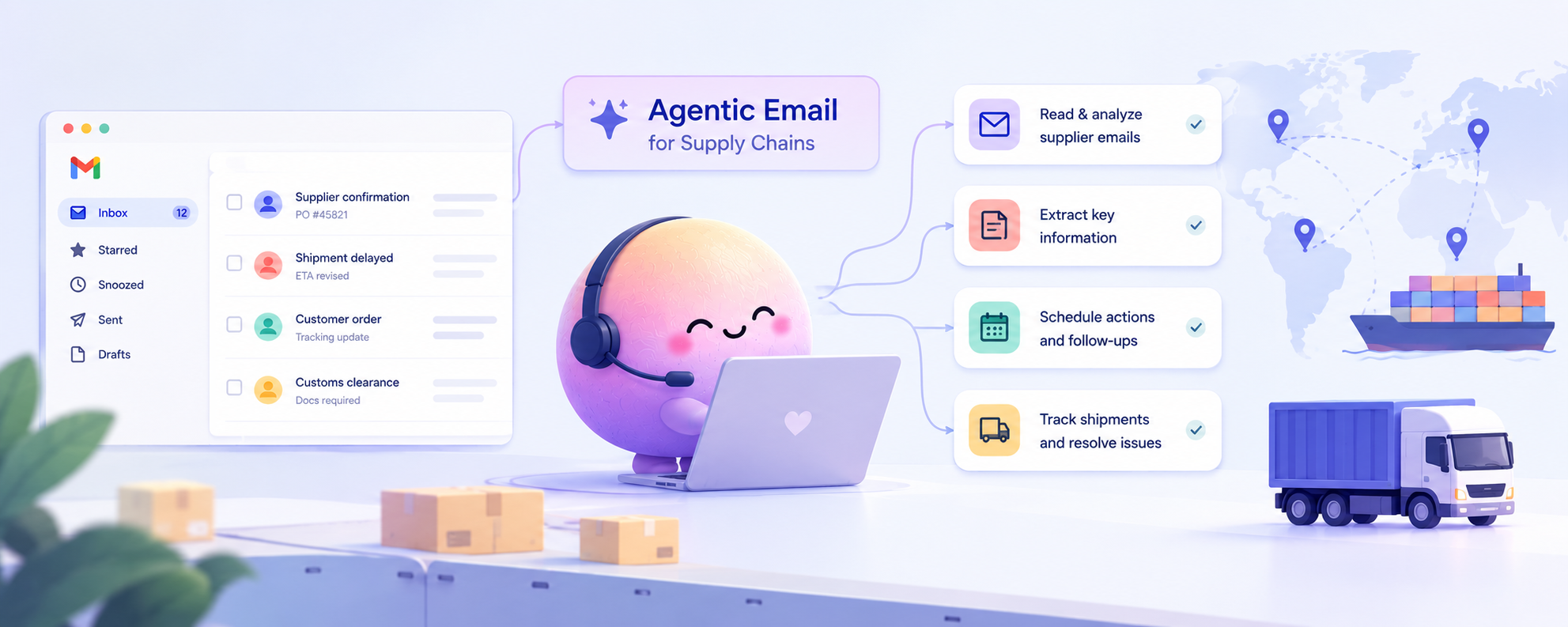



Supply chains depend on email far more than the software around them suggests. Purchase order confirmations, supplier delay notices, quality certificates, customs documents, invoice queries, and forecast changes are exchanged in the same inbox, often between companies that already share an ERP, an EDI connection, or a supplier portal.
When a supplier writes at six in the morning to say a component will ship four days late, someone has to find the purchase order, check the production schedule, warn the planner, inform customer service, and ask the supplier for options, and each of those steps is an email.
Most conversations about supply chain technology concentrate on planning engines, control towers, and forecasting models. The inbox, where exceptions are reported, negotiated, and resolved, is treated as a place where messages are stored instead of a place where work is done. Agentic email is the technology built to change that.
What is Agentic Email?
Agentic email is an inbox that acts on what it reads, using AI agent technology.
A traditional inbox waits for a person to open each message, decide what it means, and type a reply. An agentic inbox has AI agents that can read the message, check it against what the business already knows, and draft, send, or escalate a response within limits a team has set in advance, so software handles email quickly.
Why Supply Chain Teams Are Struggling
The cost of weak communication in supply chain management begins in the inbox, where exceptions are reported and resolved, and the tools around that inbox have not kept pace with the volume.
1. Exceptions are still handled by email
Structured systems removed much of the routine supply chain email, and the exceptions remain. Microsoft's own materials for its Dynamics 365 supplier communications agent describe purchase order reminders and change confirmations as manual, repetitive work, often handled by email even in organizations that use EDI.
2. Tracking consumes almost two workdays a week
A LeanDNA survey of 250 supply chain, inventory, and planning executives found that supply chain professionals spend nearly 14 hours a week tracking data by hand, much of it in a mailbox, where decades-old barriers have kept the work manual long after other functions were automated.
3. Supplier threads have no clear owner
Weak email management leaves approvals unread, supplier instructions in conflict, and nobody responsible for a thread. Shipping instructions and customs documents are still exchanged by email, and when one is overlooked, a shipment can be held at a port, charged additional fees, or sent to the wrong destination.
4. General AI tools become expensive and demand new habits
While AI agents are changing the nature of work across industries, barriers to entry remain. Popular LLM platforms become increasingly expensive as more tasks are automated, and using one means a buyer or planner has to learn another interface, familiarize themselves with another workflow, and reconnect other systems outside the inbox.
5. General AI tools do not know the business
A general tool reads one message at a time, with no record that a supplier has missed its confirmation window three times this quarter or that a buyer agreed to a partial shipment. The knowledge that would make a reply correct is in the inbox, where the tool cannot see it.
6. Trust is another concern
Teams share supplier pricing, contracts, and proprietary designs with an AI tool in the course of their work, since a tool with no established security record receives that access before it has proven itself, and each additional thread it reads widens the exposure.
How AI Agents Can Help
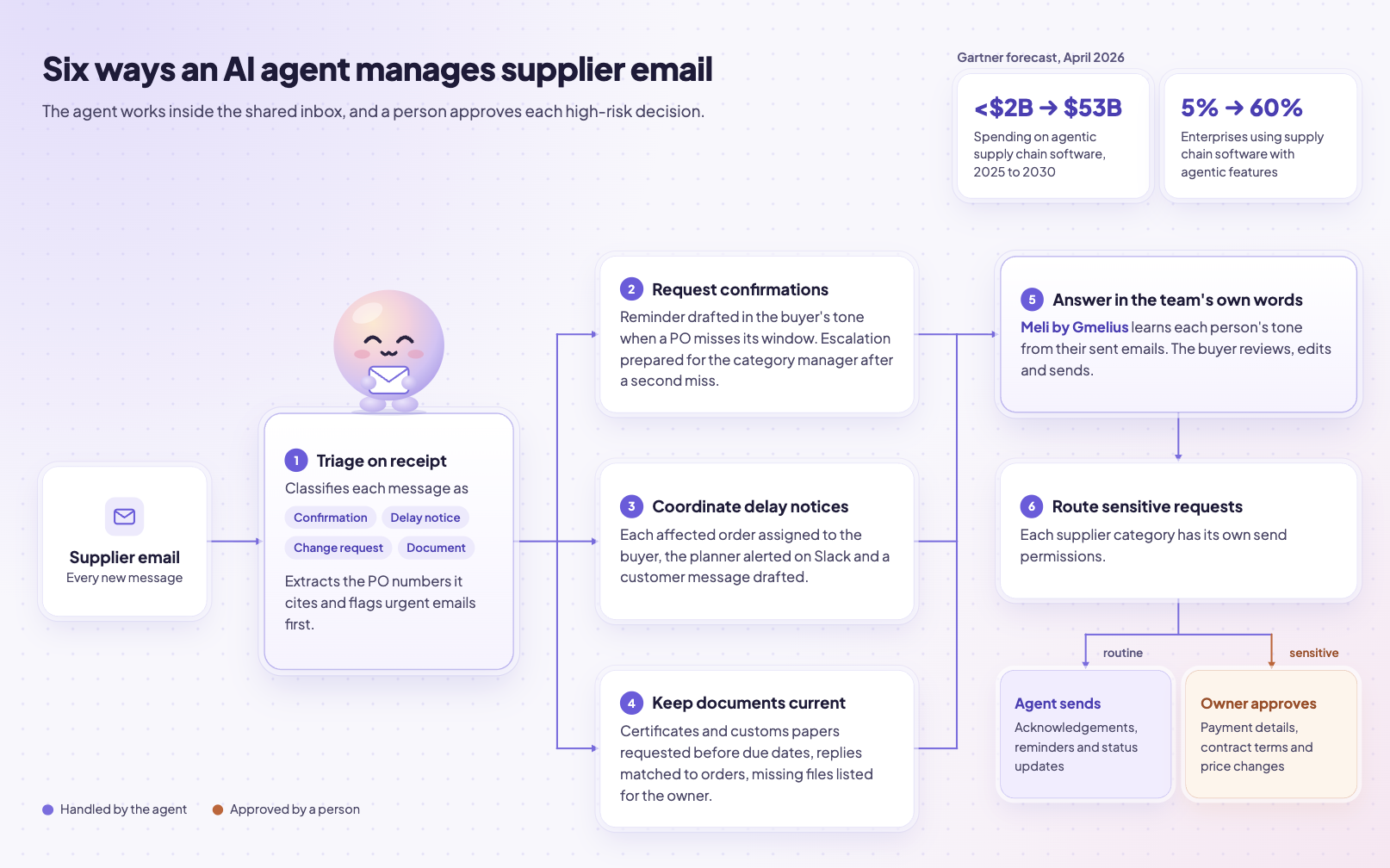
Gartner forecast in April 2026 that spending on supply chain management software with agentic AI capabilities will grow from under two billion dollars in 2025 to 53 billion dollars by 2030, and that the share of enterprises using such software with agentic features will rise from 5 percent to 60 percent, led at first by simple agents that execute discrete supply chain tasks.
1. Triage every supplier email on receipt
An agent reads each incoming message, classifies it as a confirmation, a change request, a delay notice, or a document, and extracts the order numbers it refers to, as Microsoft's Procurement Agent does inside one ERP. In supply chain communication, agents also prioritize urgent supplier emails.
2. Request confirmations when the response window closes
A reminder is ready the moment a supplier passes the agreed response time on a purchase order, in the buyer's own tone, and the agent also preps an escalation to the category manager if the second window closes without an answer. So, no confirmation depends on someone remembering to check.
3. Coordinate the response to a delay notice
Every affected order automatically triggers a delay notice. It’s assigned to the buyer, sent to the planner on Slack, and followed by a drafted message to the customer. These kinds of uses are already being seen by companies. General Motors launched SupplyAlert in 2022, after the semiconductor shortage, to alert the team members who can act on an identified risk.
4. Keep certificates and customs documents current
Requests for quality certificates and customs paperwork are sent ahead of the dates that need them, each reply is checked against the order it belongs to, and missing documents are listed for the owner of the thread, so compliance records stay complete without manual tracking.
5. Answer in the team's own words
Replies can match the tone of the person responsible for the supplier relationship when agents are used. For instance, Meli by Gmelius learns how each team member communicates by analyzing their sent email history. So when it drafts a reply to a supplier, it already reflects the tone and style of the person managing that relationship. The buyer simply reviews, makes any final tweaks, and sends.
6. Route sensitive requests to a person
Acknowledgements, reminders, and status updates are sent automatically under the permission set for each category, while payment details, contract terms, and price changes are routed to the owner for approval, which keeps the highest-risk decisions with a person and leaves the routine volume to the agent.
How to Choose an AI Agent Platform
Gartner also reported that AI assistant features have become a mandatory requirement in supply chain software selection, and that AI agents are now a common one. But a lot of products on the market have the “agent” label, while the platforms behind them tend to do different jobs. A team comparing them can ask four questions to make the final selection:
- How does it know the business? A general LLM reads documents well, and a review of Claude for supply chain operations looked at where such a model helps and where it falls short without real business context. A platform that learns from a company's own supplier history drafts replies that follow that company's terms, tone, and escalation habits.
- Where does it operate? A platform that works inside Gmail reads and drafts where buyers and planners already work, with no new login and no second interface to learn. It’s also advisable to check that servers located in a compliant region for data privacy reasons.
- How deep is the integration? An agent limited to drafting email just creates a second record to reconcile later. One that reads from and writes to an ERP, a WMS, or Slack completes the task. So, the agent shouldn't operate on shallow integrations that just create more work.
- How is permission set? Autonomy must be adjustable by workflow category, so a team can allow automatic replies for one kind of work and flag for approval approval in another.
Gmelius has published a side-by-side comparison of the best AI agents for work for teams that want to see how specific tools answer these questions.
Security and Compliance Issues
Supply chain email contains contract terms, unit pricing, proprietary designs, quality records, and supplier bank details. An agent that reads and drafts this traffic needs defined limits before it touches a working inbox.
The FBI's 2025 Internet Crime Report, released in April 2026, recorded 24,768 business email compromise complaints and 3.05 billion dollars in reported losses, up from 2.77 billion dollars in 2024, and attributed more than 30 million dollars of those losses to scams with a confirmed AI connection.
Vendor impersonation and invoice fraud are among the forms this scam takes, so an agent reading supplier email has to treat a request to change payment details very differently from a request to confirm a delivery date.
Before the first agent is activated, a team needs four safeguards:
- Certification: Independent audits such as SOC, and agreements such as HIPAA business associate terms, test a vendor's data handling against a defined standard instead of a marketing claim.
- Permission tiers: Each category of email is given its own level of autonomy, from draft only to automatic send.
- Data retention: Supply chain email regularly includes personal data covered by regulations such as GDPR, which require that information be deleted once it is no longer needed for the purpose it served, and the platform has to apply this by default.
- A visible record: Every action an agent takes is traceable to the message that triggered it, so a manager can see why a reply was sent.
None of these limits slow an agent down once they are active, and together they allow a team to give an agent real autonomy over routine work.
How Meli Delivers Safe and Purpose-Built AI Agents
Gmelius is an SOC and HIPAA-certified AI company bringing agentic technology to an environment where supply chain teams already spend a large portion of their workday, their inbox. Its agents are powered by Meli, the Gmelius AI Chief of Staff, which continuously learns about a business from its inbox, work patterns, writing style, and team workflows.
Each agent combines a trigger, such as a supplier reply with a revised delivery date, an action, such as drafting and assigning a response, an integration, such as Slack or an ERP connected through the Gmelius API, Zapier, or Make, and a permission that sets its autonomy, from writing a draft to replying alone.
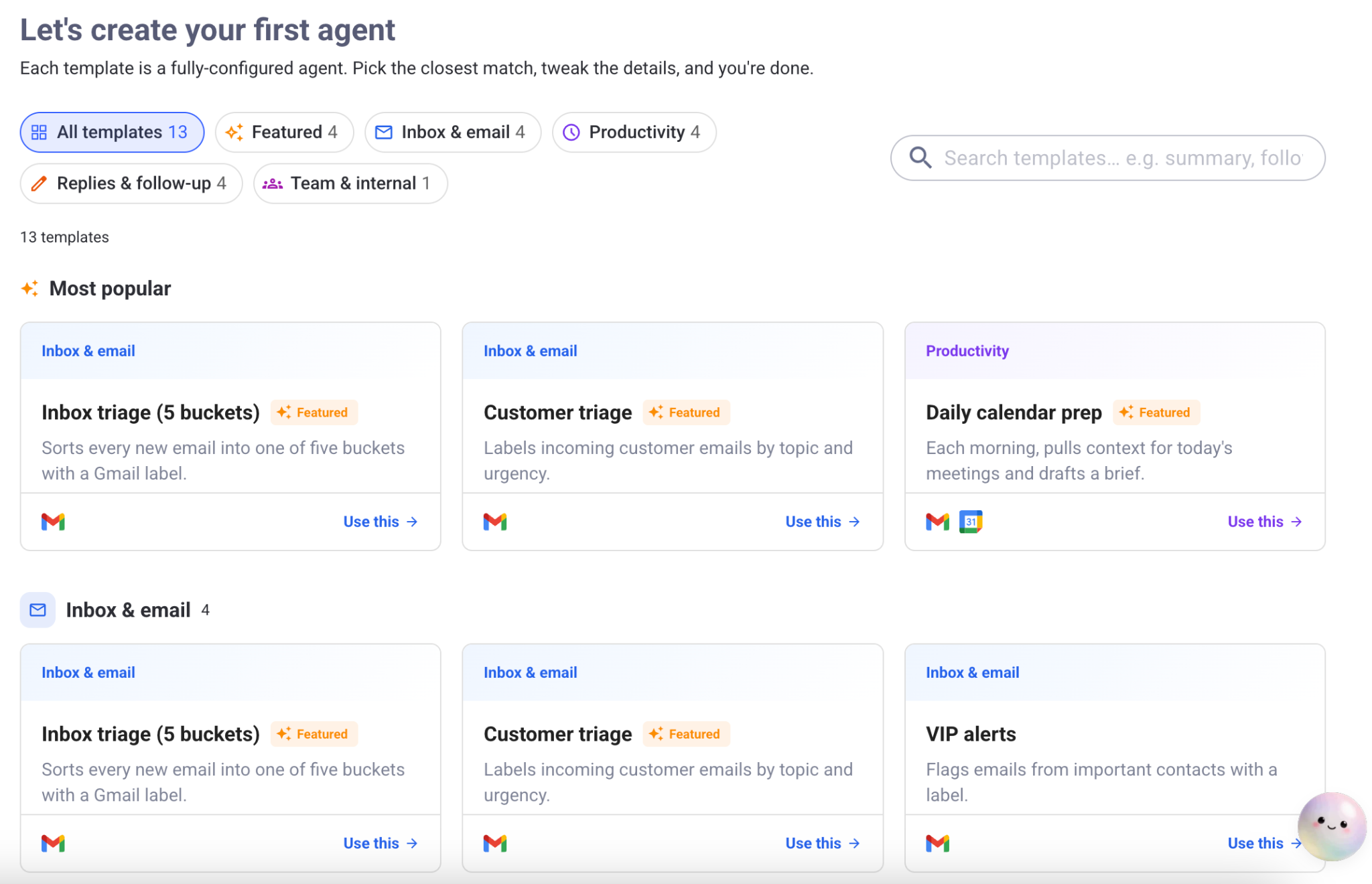
Meli also works as a conversational agent builder, so a buyer can describe what they expect from an agent in plain language and have it constructed inside the Gmelius interface in minutes, or start with pre-built agents that cover 11 common workflows, including quick acknowledgements, team inbox summaries, and VIP contact alerts. It works natively inside Gmail, without extra tools or heavy prompting, and delivers the AI assistant features that drive real productivity gains in 2026.
How Supply Chain Teams Benefit
Keelvar research reported in June 2026 found that 69 percent of leaders say the speed and quality of decision-making creates internal obstacles for their organizations, and that businesses adopting AI or automation across sourcing and supply chain operations are 3.7 times less likely to suffer during market volatility.
1. Replies are ready when the buyer opens the inbox
Gmelius reports that each time a user opens Gmail, Meli has replies ready in the user's tone, tailored to the context and based on insights from thousands of past emails, and positions this as returning about an hour a day to each user.
2. Confirmations and documents stop slipping
Service level rules and auto-assignment, both revamped by Gmelius in 2025, send each supplier message to the right owner with a response deadline, and an agent drafts the reminder when the deadline passes, so a missed confirmation is noticed on the day it is missed.
3. Every supplier thread has an owner
Gmelius shared inboxes have long been used in procurement and supply chain management to give every supplier thread an owner, with internal notes beside each email and a Kanban board that shows which phase each order is in, and agents add automatic first responses and follow-ups to that structure.
4. Delays are seen earlier
A delay notice is read on receipt, matched to the order, and shared with the planner in Slack within the same hour, so decisions about alternative suppliers or expedited freight begin with current information instead of a forwarded chain.
5. Setup uses the data a team already has
Gartner expects enterprise deployments to lag behind the availability of agentic features, because data management, operations management, and workforce readiness have to develop first, and a team whose supplier history is already stored in its inbox does not have to build a separate data layer before Meli can learn from it.
Supply Chain Coordination Beyond Email: Switching to AI Agents
Many teams still assemble this picture by hand, and a Gmelius walkthrough shows how supply chain spreadsheets can be converted into dashboards with Claude prompts while describing the limit of the method: a dashboard shows where the problems are but cannot contact a supplier about any of them, which is the step an agent takes.
Supply chains will keep exchanging purchase orders, confirmations, and delay notices by email, and what changes is how much of that volume still needs a person to open the message, decide what it means, and type the reply by hand.
Gmelius works inside Gmail, so a supply chain team can begin without a new platform or a migration, and every new account opens the Growth plan for seven days. In that time, a team can connect the inbox that receives supplier email, let Meli learn from it, and describe a first agent in plain language, such as a reminder for every purchase order left unconfirmed after 48 hours.
Start your 7-day free trial and give your supplier inbox a chief of staff.