%20(1).avif)



Vendor Onboarding Checklist Template for Freight Carriers Running Email Ops
How many carriers in your TMS right now were never fully verified — they just got busy enough that someone assumed compliance handled it?
For most freight ops teams, the honest answer is: a few. Maybe more. Not because the process doesn't exist, but because the process lives in a Google Doc and the work lives in Gmail. When those two things aren't connected, steps get skipped under pressure and nobody finds out until a claim lands.
This guide covers what is vendor onboarding for freight carriers, how the vendor onboarding process works end to end, where it breaks, and how to build it into your inbox architecture so it runs the same way every time.
What Is Vendor Onboarding for a Freight Carrier?
So what is vendor onboarding, exactly? Vendor onboarding is the process of qualifying, documenting, and activating a new carrier, broker, or supplier relationship so that your team can dispatch loads, process payments, and maintain compliance records without scrambling every time a thread goes cold.
Who Counts as a Vendor When You're a Freight Carrier
Depending on your model, your vendor pool might include:
- Sub-carriers and owner-operators you broker loads to
- Freight brokers who source loads for your trucks
- Fuel and maintenance suppliers under negotiated terms
- Factoring companies with notice of assignment (NOA) requirements
- Port agents and customs brokers for import/export lanes
Each relationship has different documentation requirements, compliance thresholds, and approval chains. The intake form for a spot owner-operator looks nothing like the packet for a new customs broker.
Why Email Is Where Vendor Onboarding Actually Lives
Every major TMS promises to centralize carrier onboarding. In practice, the first five steps of every new relationship happen in email — because that's where carriers, brokers, and agents already are. They don't log into your portal. They reply to whoever reached out, attach their COI to a Gmail thread, and wait.
An automated carrier onboarding process is 80% faster than a manual one — but most automation tools assume the process starts inside a platform. For freight teams, it starts in the inbox.
Onboarding a One-Time Spot Vendor vs. a Contracted Lane Partner
These are not the same process. A spot vendor needs: FMCSA authority check, valid COI, W-9, and TMS entry. The goal is activation within hours. A contracted lane partner needs all of that plus lane capability data, equipment specs, rate confirmation, and a signed SLA. Don't make your dispatcher wade through a 12-step compliance process to cover a load that ships in six hours.
The Vendor Onboarding Process from First Email to First Dispatch
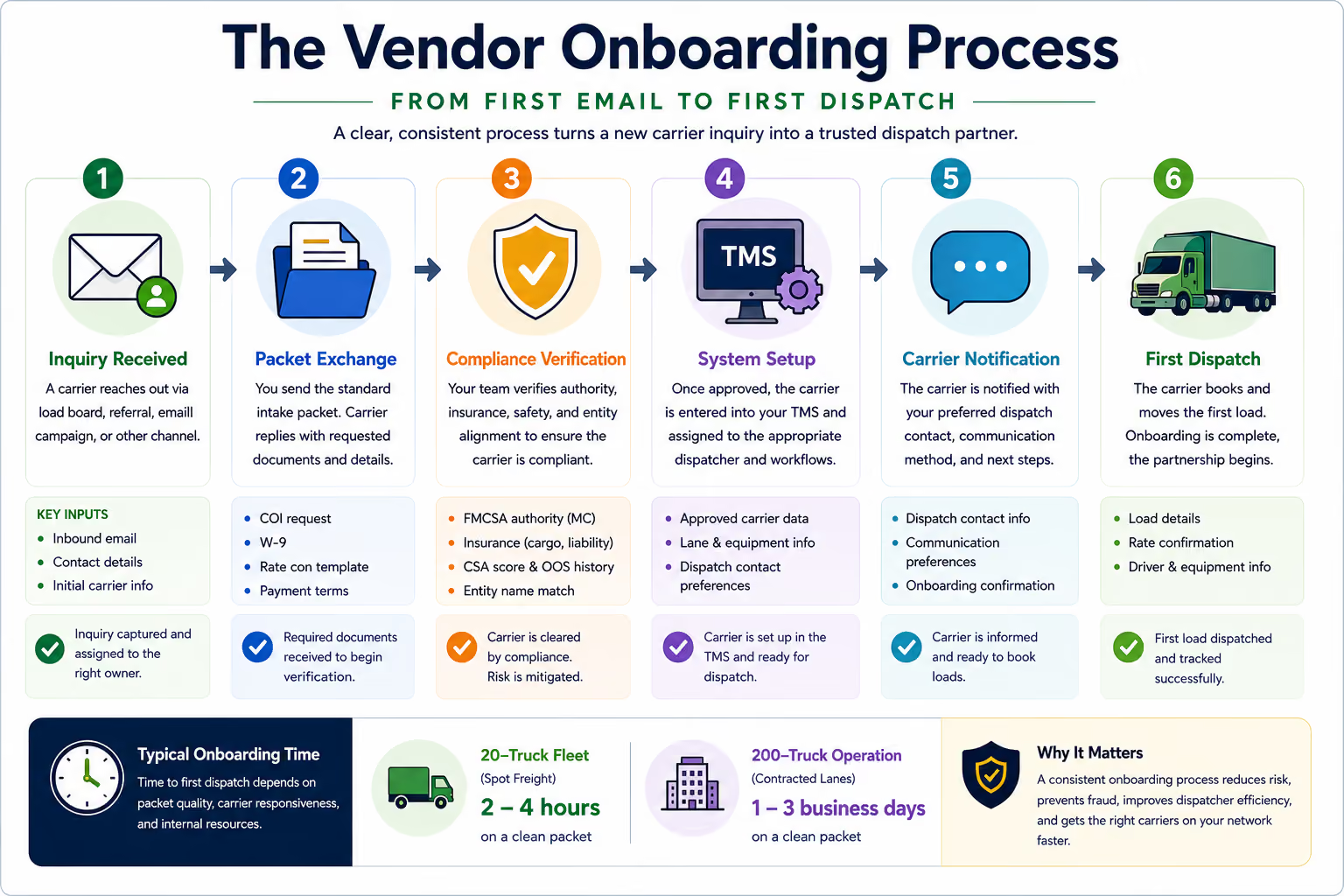
Understanding what is vendor onboarding in a freight context means following every handoff (from first contact to active status in your TMS) and knowing who owns each step.
How a Vendor Relationship Usually Starts
Most new carrier contacts arrive via inbound email from a load board, a broker referral forwarded into your ops inbox, or an outbound carrier development campaign. In all cases, the first message lands in someone's Gmail — and whether it gets handled consistently depends entirely on whether that inbox has rules, owners, and a defined intake flow.
The Packet Exchange
The standard intake packet your team sends should include: your carrier setup form, a COI request naming your company as certificate holder, a W-9, a rate confirmation template, and your payment terms. What comes back generates four to eight separate email threads across two to five people on each side, often with attachments re-sent because the original went to the wrong address.
Compliance Verification
Before any carrier moves a load, your compliance team needs to confirm:
- FMCSA operating authority (MC number, active status via FMCSA SAFER)
- Insurance: cargo, liability, and any lane-specific coverage
- Safety score: CSA scores and out-of-service history
- Entity name match: the name on the W-9, the COI, and the FMCSA record must align exactly
Highway's 2025 Freight Fraud Index documented nearly 2 million fraudulent email attempts blocked over the year, with fraud increasingly shifting from impersonation schemes to direct theft. Compliance verification isn't bureaucracy — it's your ops team's first line of defense.
System Setup and First Dispatch
Once compliance signs off, the carrier gets entered into your TMS, assigned to the right dispatcher, and notified with your preferred dispatch contact. For a 20-truck fleet running mostly spot freight, this cycle should take two to four hours on a clean packet. For a 200-truck operation with dedicated compliance staff, expect one to three business days for a contracted lane partner.
Vendor Onboarding Form Essentials
The Non-Negotiables: COI, W-9, MC Authority, FMCSA SAFER Snapshot
These four items are the minimum viable packet for a spot load. Everything else is layered on top for contracted relationships. The COI request should specify that your company is named as certificate holder — not just listed as an additional insured — and should include the carrier's insurance agent contact so you can verify directly.
Payment Terms, Factoring NOAs, and Quick-Pay Agreements
If a carrier uses a factor, you need their NOA before you can process payment. Your intake form should ask upfront. Quick-pay agreements should be standardized across your team — informal terms negotiated over email create accounting problems that surface only when a claim hits.
Lane and Equipment Capability Data That Dispatch Actually Uses
- Equipment type (van, flatbed, reefer, specialized)
- Home base and preferred lanes
- Max weight and length
- Hazmat certification if applicable
- Preferred load notification method
An intake form that misses this forces dispatchers to call the carrier every time they want to check availability.
A Vendor Onboarding Checklist Template Built for Email-Based Ops Teams
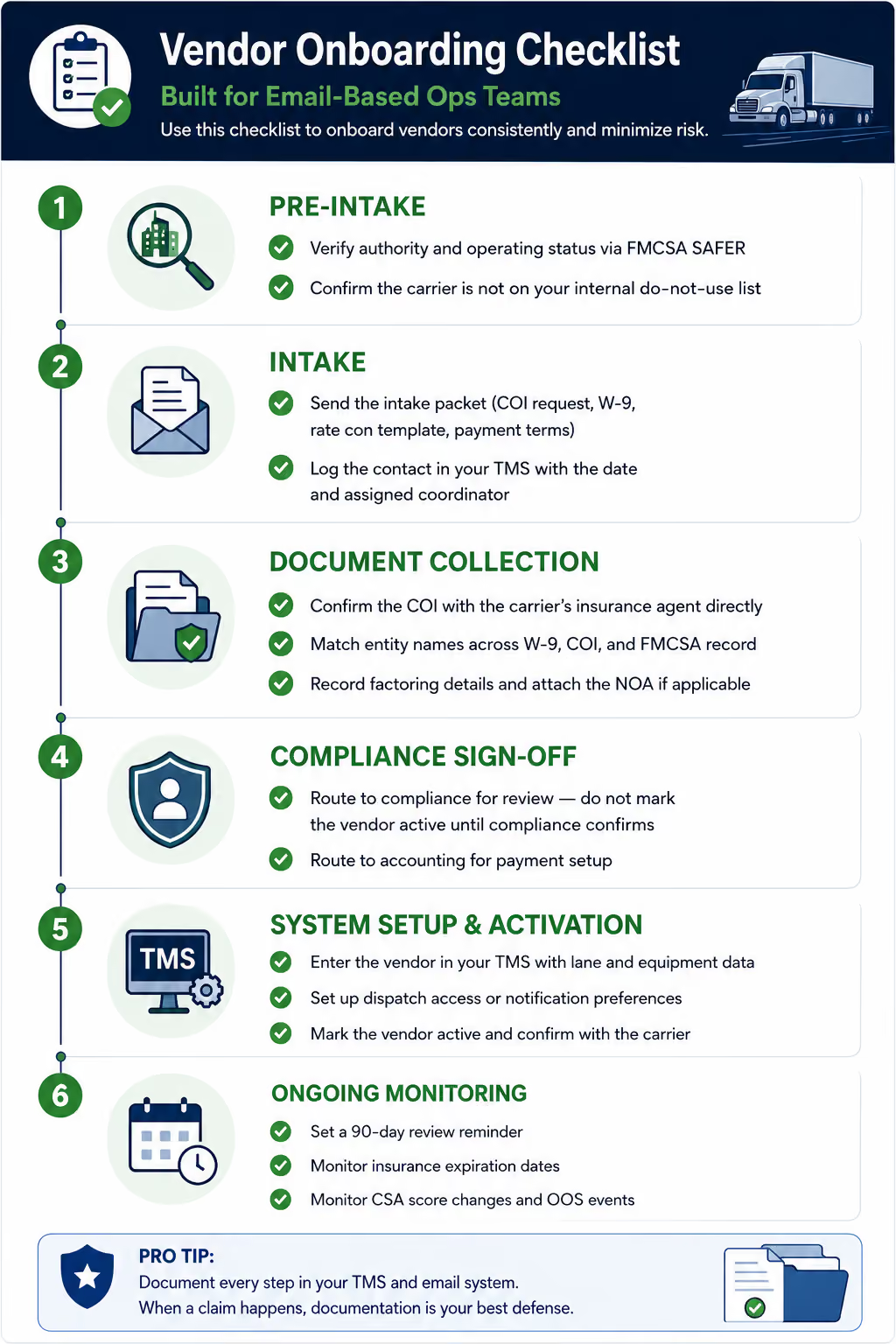
Pre-intake
- Verify authority and operating status via FMCSA SAFER before sending the packet
- Confirm the carrier is not on your internal do-not-use list
Intake
- Send the intake packet (COI request, W-9, rate con template, payment terms)
- Log the contact in your TMS with the date and assigned coordinator
Document collection
- Confirm the COI with the carrier's insurance agent directly
- Match entity names across W-9, COI, and FMCSA record
- Record factoring details and attach the NOA if applicable
Compliance sign-off
- Route to compliance for review — do not mark the vendor active until compliance confirms
- Route to accounting for payment setup
System setup and activation
- Enter the vendor in your TMS with lane and equipment data
- Set up dispatch access or notification preferences
- Mark the vendor active and confirm with the carrier
- Set a 90-day review reminder for insurance expiration and CSA score changes
Mistakes That Slow Down a New Vendor Onboarding Process
Most onboarding delays don't come from compliance requirements themselves. They come from breakdowns in ownership, visibility, and follow-through. A carrier may have every required document submitted, yet still sit in limbo because nobody knows who owns the next step. These are the most common bottlenecks freight ops teams encounter when onboarding new vendors.
1. Email Threads with No Clear Owner
When a carrier packet arrives in a general ops inbox that five people monitor loosely, it either gets handled twice or not at all. The fix is not a new tool. It's a defined owner for every thread the moment the email arrives.
2. Documents Collected but Never Verified
Getting the COI back from the carrier does not mean the COI is valid. Verification requires a direct call or email to the issuing agent — a step that disappears when the team is moving fast.
3. Missing Audit Trails When Compliance Asks
Six months after a carrier hauls a load that results in a claim, your compliance team will ask: "When did we verify their insurance? Who signed off?" If that answer lives in someone's inbox thread, you have a problem. Every verification step should be logged to the carrier's TMS record at the time it happens.
4. Onboarding Stalls Nobody Notices Until a Load Needs to Move
A carrier 80% through onboarding, waiting on compliance sign-off, with no follow-up — then a dispatcher needs them Friday afternoon and discovers the carrier was never activated. The load goes spot at a premium. Visibility into in-progress onboarding is a direct cost driver.
Vendor Onboarding Best Practices Carriers Learn the Hard Way
These vendor onboarding best practices come from ops teams that have run the process at scale — and felt where it breaks.
Build intake templates dispatch will actually use at 2am. Your carrier packet should be sendable in three clicks, at any hour, from any device — living inside your inbox architecture, not a Google Doc someone has to find.
Tiered onboarding matters. Two distinct checklists: one for spot carriers (two to four hours), one for contracted lane partners (one to three days). Applying the full compliance process to every spot carrier creates drag. Applying the spot process to a new dedicated partner creates exposure.
Set up insurance expiration alerts before they bite you on a claim. Set a trigger 30 days before every active carrier's COI expiration date. This is one of the highest-value, lowest-effort improvements an ops team can make.
Standardize intake across dispatchers. If each dispatcher runs their own version of carrier onboarding — different forms, different filing habits — your carrier records will be inconsistent at exactly the moment compliance needs them.
Set SLA expectations with new vendors from day one. "We activate within 24 hours of a complete packet" is a specific commitment that sets expectations and surfaces your internal bottlenecks.
How to Automate Vendor Onboarding Without Replacing Your Whole Stack
The global carrier onboarding platform market reached USD 1.42 billion in 2024 and is projected to grow at a CAGR of 13.1% through 2033, driven by freight operations trying to automate what is currently done manually in email. But most of that market is built around standalone platforms — another tool your dispatchers won't open at 2am.
The more practical path is to automate the process where it already lives: the inbox. This is what a structured inbox architecture with automation agents makes possible. For context on where the agentic AI category is heading, see our agentic AI statistics and breakdown of the best AI agents in 2026.
Routing inbound carrier packets automatically. When a new carrier emails your ops inbox, an automation agent classifies the email, assigns it to the right coordinator by lane or region, and tags it as "pending intake" — before a human sees it.
Auto-sending document requests. Instead of composing a packet request manually every time, an automation agent detects a new carrier introduction and sends your pre-built intake template immediately. Response time drops from hours to seconds.
Triggering compliance review when all docs are in. Once document collection is complete, an automation agent routes the thread to compliance, updates the TMS status, and notifies the compliance coordinator — without anyone manually forwarding the thread.
Tracking onboarding status inside Gmail. A Kanban view inside your inbox architecture shows every carrier in onboarding, their current stage, their assigned coordinator, and how long they've been stuck. No separate dashboard. No status meeting.
Picking Vendor Onboarding Software That Works for a Freight Operation
Choosing the right tool for carrier onboarding comes down to one question: does it work where your team already operates, or does it require them to change how they work?
Standalone Onboarding Platforms vs. Email-Native Tools
Dedicated carrier onboarding platforms offer deep compliance features — FMCSA API integrations, automated SAFER lookups, insurance tracking — and for large brokerages onboarding hundreds of carriers per month, the investment is justified. The same applies to supplier onboarding in non-freight contexts, where volume and complexity justify a dedicated vendor onboarding platform. For a 20- to 200-truck operation, the adoption overhead often outweighs the benefit when your team's workflow begins and ends in email. Our guide to freight operations software covers how different tools fit together across the ops function.
Integration with Your TMS and Accounting Stack
The question is not "do you have an integration?" It's "when I mark a carrier active in your tool, what exactly updates in my TMS, and who triggers it?" Ask the same about accounting: when a W-9 is received and the carrier is activated, how does that flow into your payment setup?
The Questions to Ask on a Demo That Vendors Won't Answer in Marketing Copy
Before committing to any platform, ask — these are the questions that separate serious vendor onboarding tools from generic workflow apps:
- "Show me what happens when a carrier emails a document to the wrong address."
- "How does a dispatcher check onboarding status without logging into your platform?"
- "What happens when a COI expires — who gets notified, and how?"
- "Can we run two different onboarding workflows for spot carriers vs. contracted partners?"
The Bottom Line
A vendor onboarding checklist is only as good as the system it runs inside. For freight ops teams working out of Gmail, that system is the inbox — and Gmelius is built specifically to turn it into a structured workflow management system with defined owners, automation agents, and full visibility into every carrier thread from first contact to active status.
If your current onboarding process depends on people remembering to check a Google Doc, it's already breaking under pressure. Gmelius gives your team the inbox architecture to make the checklist stick without adding another platform to your stack.
Ready to see how Gmelius works for freight ops teams? Try it for free.


.avif)
.avif)
.avif)
.avif)
%20(2).avif)