


Two years ago, the average office had one AI assistant open in a browser tab, and it was almost always ChatGPT. The picture looks different in October 2026. Claude has won a large following among writers and developers, and the question now gets asked in a great many meetings where software budgets are discussed.
So, is Claude better than ChatGPT? For writing and for long, careful work, the answer is yes. For the sheer range of features in a single app, ChatGPT still has the advantage. For most teams, the better pick depends on the work you do all day.
The Two LLM Line-Ups for Q4 2026
We have compared ChatGPT vs Claude before, but both companies shipped new models within three weeks of each other this autumn, and the product names have grown rather crowded.
Anthropic released Claude Opus 5.5 on September 22, calling it the first of a new 5.5 family. Opus is the largest of Claude's three everyday models. Sonnet 5.5 followed on September 28, and Haiku 5.5 was introduced on October 7 at about a quarter of Haiku 4.5's running cost.
Above Opus, Anthropic keeps a separate Mythos tier. Claude Mythos 5.1 is restricted to security partners, while Fable 5.1 uses the same model with extra safeguards and is open to the public. By Anthropic's account, Opus 5.5 performs at Fable's level on most tasks and costs far less.
OpenAI rebuilt its range around GPT-6, which was released to every ChatGPT user on October 7 after a September launch for paid plans. Paying subscribers chat with GPT-6 Sol, and free users get GPT-6 Luna. The strongest model, GPT-6 Astra, is aimed at developers and Codex.
Which One Writes Better?
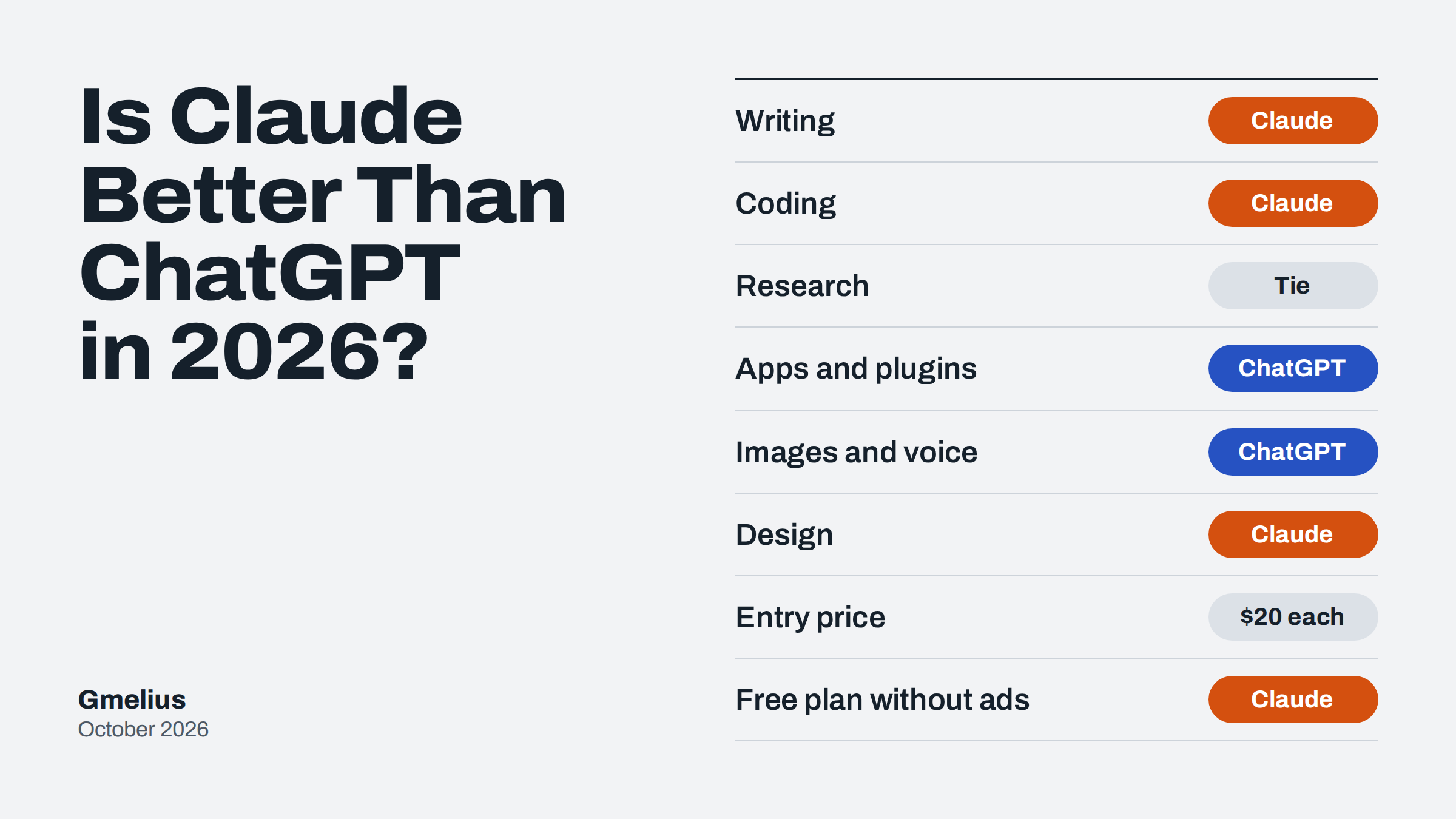
Writers have preferred Claude for some time, and the 5.5 models give them no reason to change. Ask both assistants for a client email, and Claude's draft will usually read closer to a person's work. Its sentences vary in length, and its vocabulary stays plain.
Claude also follows instructions closely, which helps any team with a style guide. A house style can be written once as a Skill, and Claude applies it whenever a task calls for it. It's also possible to create a Claude Skill without technical knowledge.
OpenAI spent the GPT-6 release on a different problem. Its new Intelligent UI lets ChatGPT answer with charts and small working tools inside the chat, such as a calculator or a bill splitter. That helps a great deal with explanations and planning, though a cover letter gains nothing from it.
For long drafts that must sound like a person, Claude remains the safer starting point. Either way, the brief decides most of the result, and knowing how to ask an AI assistant questions can help produce usable first drafts on either of these platforms.
Coding and Long-Running Jobs
Software has been Anthropic's strongest field, and Opus 5.5 was built for it. Anthropic reported 66.4% on Terminal-Bench 4.0, ahead of GPT-6 Astra's 57.9%, and said one tester migrated 680,000 lines of code in under a day, a job it said would otherwise take an engineering team weeks.
OpenAI's answer to Claude Code is Codex, which now offers GPT-6 Astra. Codex can ask clarifying questions in the middle of a long task, and GPT-6.1 Sol can pass separate parts of a job to subagents through the API. Developers who already work in Codex have less reason to move.
Both companies also sell models that operate a computer by clicking and typing like a person. On Anthropic's own figures, Haiku 5.5 scored 72.4% on the offline OSWorld 2.1 test against 48.9% for GPT-6 Luna, a wide margin between two models sold at the same price.
Office workers have their own versions of these agents. Claude Cowork completes multi-step tasks from a folder of files, and ChatGPT Work produces editable Office files and hosted Sites.
When Anthropic studied 1.2 million Cowork sessions in July, business operations made up a third of the work and coding less than a tenth. For coding itself, Claude remains the stronger default, with Codex a close second.
Search, Research and Accuracy
ChatGPT has offered web search since late 2024, and GPT-6 improved it again. OpenAI says GPT-6 Instant starts answering search questions 44% sooner than GPT-5.6 Instant. For quick factual questions in the middle of a working day, the speed is noticeable.
Claude searches the web too, and its Research mode spends several minutes reading sources before writing a cited report. ChatGPT offers a similar deep research tool, and the two assistants are closer on this front than on any other.
Neither tool should be quoted without checking. OpenAI says GPT-6 is better at recognizing its own limits, and Anthropic reported the strongest alignment score of any Claude model for Opus 5.5. Both still make mistakes, so a cited source should be opened before its number appears in a client report.
Plugins, Connectors and the Inbox
ChatGPT has the larger catalog. Its directory listed more than 1,400 plugins this summer, and ChatGPT also generates images with GPT Image 2.5, released in September. Claude has no built-in image generator of that kind, and for many marketing teams that alone decides the choice.
Anthropic wrote the Model Context Protocol in 2024, and both companies now use it for their connectors. Claude also works inside Excel and PowerPoint, which suits teams that spend their day in spreadsheets and slide decks.
Email shows the limits of both assistants, as, while each can read a Gmail inbox through a connector and draft replies from it, neither can manage a shared address such as support@ the way a team needs, with clear ownership of every thread and a record of who answered.
In fact, that gap is the reason Gmelius built Meli inside Gmail itself. Our report on why the inbox is dead explains the thinking behind it, and our roundup of the best AI agents for work compares the tools that handle team email, in a way that neither ChatGPT nor Claude is capable of.
Images, Voice and Design
Images are ChatGPT's clearest win. OpenAI released ChatGPT Images 2.5 on September 8 with sharper details and more precise editing, and added templates and a sketch-to-image tool on mobile. Claude has no image model to match it, so a marketer who needs a banner should open ChatGPT.
Voice is closer than it was because ChatGPT's GPT-Live-1 listens and speaks at the same time, so it can be interrupted in the middle of a sentence. Since October 6, paid subscribers can also upload audio files and ask for a transcript or a summary.
Claude's voice mode still waits for each turn to finish, though since July it has used Opus and Sonnet and can work with connected apps such as Gmail once permission is given. For voice and audio, ChatGPT keeps the lead.
Design is the one visual area where Claude has the stronger product. Anthropic launched Claude Design in April, a canvas where Claude builds prototypes and slide decks from a description using a team's own colors and fonts. Finished work can be exported to Canva or handed to Claude Code.
Claude also reads images closely. Anthropic reported 89.0% for Opus 5.5 on Chartography, a test of reading data from charts, which helps anyone who pastes a dashboard screenshot and asks what changed.
So, is Claude better than ChatGPT for multimodal work? For images and voice it isn't, but a team that designs slides and prototypes will find Claude Design the more useful canvas.
How Much Does Each One Cost?
At the entry level, the two cost the same. Claude Pro and ChatGPT Plus are both $20 a month, and both companies sell heavier plans for people who use agents all day.
ChatGPT offers a wider range. Its $8 Go plan suits light users, and its top Pro tier at $500 is the only Pro plan with OpenAI's Ultrafast mode. Claude's Max plans are simpler, offering five or twenty times the Pro allowance.
Ads, Privacy and Trust
OpenAI began showing ads on ChatGPT's Free and Go plans in the US on February 9, 2026, and published plans for new ad formats on October 5. Plus and every plan above it remains ad-free.
Anthropic made the opposite promise in February. In a post titled Claude is a space to think, the company said Claude will remain ad-free, arguing that ads would create an incentive to optimize for engagement. Anthropic earns its money from subscriptions and business contracts instead.
Both services save conversation history, and both allow it to be deleted. Gmelius has a guide on how to delete ChatGPT and Claude history for anyone who has shared client details with either tool. On business plans from both companies, chat data is excluded from model training by default.
So, is Claude Better than ChatGPT?
For teams that write or code for a living, Claude is the better assistant in October 2026. Its drafts need fewer edits, and Opus 5.5 offers Fable-level performance at a lower price than Opus 5. Marketing writers and developers will notice the difference within a week.
ChatGPT is the better pick for anyone who wants one app for everything. It generates images and builds small interactive tools inside an answer, and its plugin catalog is the larger of the two. Free users should remember that it shows ads, while Claude's free plan doesn't.
Some teams will pay for both, at $40 a month per person. The surest test takes a week. Give both assistants the same real tasks from your own work, then keep the one whose output needed fewer corrections.
Conclusion
Is Claude better than ChatGPT for a working team in 2026 and preparing for the new year, in 2027? For writing and code it is, and ChatGPT remains the broader app for images and voice. Both, however, were designed around the conversation of a single person.
Most business work doesn't happen in a chat window. It happens in a shared inbox, where a client's question has to be assigned to the right person and answered in the team's voice.
Gmelius was built for that part of the job. Meli, our AI agent, works inside Gmail and drafts replies from the live thread, while the shared inbox assigns each conversation and keeps a record of who answered. Meli also powers an army of AI agents to complete tasks automatically across applications. And unlike ChatGPT or Claude, Gmelius already knows all about your business, workflows, and team structures, making everything more intuitive.