



Meta's Muse, a personal AI agent that does jobs for people instead of only answering their questions, has become one of the fastest-growing apps of the year. It passed five million downloads in the US within 22 days of its September 8 launch, a figure that ChatGPT took 56 days to match.
Muse is also Meta's biggest consumer bet on AI since the company began rebuilding its AI research in the summer of 2025, an effort on which Meta expects to spend as much as $145 billion this year.
On October 12, the same lab released Muse Wonder, a larger family of models that Meta says can compete with the best systems from OpenAI and Anthropic. Most people call it Wonder AI, and paying Muse subscribers will be the first to use it inside the app.
When the app is opened for the first time, Muse offers to connect to Gmail and Facebook, so it asks for a good deal of trust from the start. This guide explains what Muse and Wonder can do, and what they ask of the people and businesses that use them.
What Is Meta Muse?
Meta's Muse is a personal AI agent that does jobs for people instead of only answering their questions.
Muse comes from Meta Superintelligence Labs, the group led by Alexandr Wang, whom Meta hired as chief AI officer after it bought 49% of Scale AI for $14.3 billion in June 2025. The agent is built on Muse Spark, the lab's first model, which Meta released in April 2026.
On screen, Muse looks like an ordinary message thread, in which a person types a request, much as they would text a friend, and the agent replies in the same window, or inside WhatsApp, which Meta also supports. Each person can name the agent and choose an avatar for it.
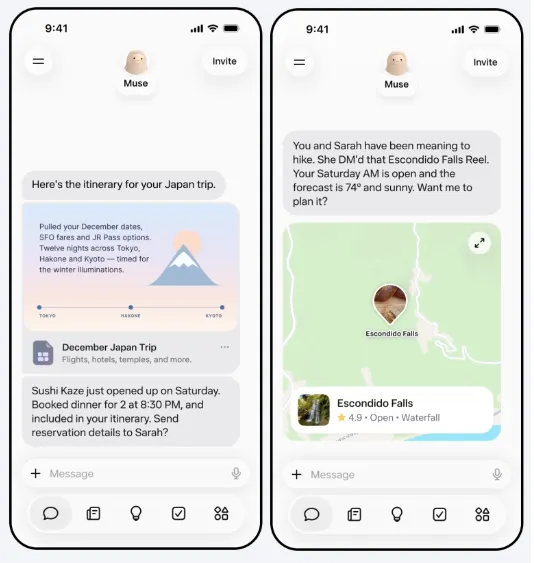
Every Muse has its own virtual machine in Meta's cloud, called the Muse Secure VM, and the AI agent uses a browser on that machine to complete forms and place orders while its owner watches or does something else.
A chatbot answers a question and stops, whereas Muse keeps working after the app is closed and sends a message when it needs approval, for example, before it sends an email or pays for something.
Meta's own example of Muse's memory is a recipe reel saved on Instagram, which Muse can use to write a grocery list, and it will remember a friend's dietary needs before it sends the invitations to a dinner party.
According to Apptopia, more than 95% of Muse users also use Facebook, and Sensor Tower found that Meta began a large advertising push for the app on September 16, after which downloads rose by 73% in a single day.
What Is Wonder AI?
Wonder AI is the common name for Muse Wonder, a pair of agentic AI models that Meta released on October 12. The smaller one, Muse Wonder, is sold to developers through the Meta Model API, while the larger one, Muse Wonder Full, is kept for subscribers to Muse Code, Meta's coding agent.
Both were trained at Prometheus, a new Meta data center in central Ohio, and they are the first models from the lab that Meta describes as frontier models, which means they compete with the strongest systems on the market.
Wonder's first new ability is Active Memory, which lets the model recall useful details from earlier conversations. The second is Active Focus, which keeps the model working on a hard task and makes it try another approach after a mistake.
Alexandr Wang told CNBC that the model, codenamed Watermelon, was trained so that agents would stop failing at everyday jobs, such as booking a table for dinner. Meta also says that Wonder handles expert work in law and finance, and that it codes at the level of the leading models.
On Meta's own scorecard, Wonder leads on MemoryBench, a memory test that Meta built itself, with 85.6 against 81.5 for Claude Opus 5.5, but Opus 5.5 wins nine of the fourteen tests in the same table.
On the Artificial Analysis Intelligence Index, an independent ranking, Wonder scores 52 and Wonder Full scores 56, while Opus 5.5 scores 58, and the same firm lists Wonder among the more expensive models to run.
Meta Muse and Wonder AI Capabilities
Meta has added features to Muse every two or three weeks since September 2026, and Wonder adds new skills on top of them.
1. Errands from start to finish
Muse can book a trip or negotiate a lower bill, and it keeps working on the job after the app is closed, which is a key difference between an AI agent vs. a chatbot. It asks for approval before the final step, such as sending an email or paying for an order.
2. Shopping and payments
When it is time to pay, Muse uses Link by Stripe, which creates a one-time card number so that the real card details stay hidden. Meta has signed retailers such as Walmart and Sephora as partners, although Amazon blocked the AI agent from its own website on September 21.
3. An email address of its own
At its Connect event on September 23, Meta announced that each Muse will have its own email address. A person can forward a message to it or copy it into a thread, and the agent will act on what it reads.
4. Inbox triage and first drafts
Meta says Muse flags emails that need a reply and writes first drafts for them. The owner decides whether it may only read the mail or send it as well.
5. Small business connectors
Muse for Small Business, released on September 29, connects to tools such as Slack and QuickBooks, as well as to Facebook Pages and Instagram business accounts. Meta says that once these are connected, the agent already knows what the business sells and how its brand sounds.
6. Memory across conversations
Muse remembers details that a person mentioned only once, and Wonder's Active Memory is designed to bring those details back when a later task needs them. A person can also ask Muse to forget a topic.
7. Long, difficult jobs
Meta built Wonder's Active Focus for work such as an insurance claim or a lease review, where an agent must read dense documents and continue after a setback. It also asks a question when it is unsure, instead of guessing.
8. Coding
Developers can use Wonder through the Meta Model API or inside Muse Code. On Meta's own figures, Wonder scored 78.8 on DeepSWE, a test of long software tasks, which put it ahead of Claude Opus 5.5 and GPT-6 Astra in the same table.
9. Voice and glasses
In voice mode, the Muse AI agent keeps working in the background while a person is still talking, and Meta has shown a Realtime Avatar for video conversations. Muse is due on Meta's AI glasses in the coming months, where it will act on whatever the wearer is looking at.
10. Phone calls to businesses
Meta has tested a feature in which Muse telephones businesses for its owner. In September, 404 Media reported that some of these Muse AI calls had been made by human call-center workers during testing, and Meta said it would add disclosures before a public release.
Availability and Pricing
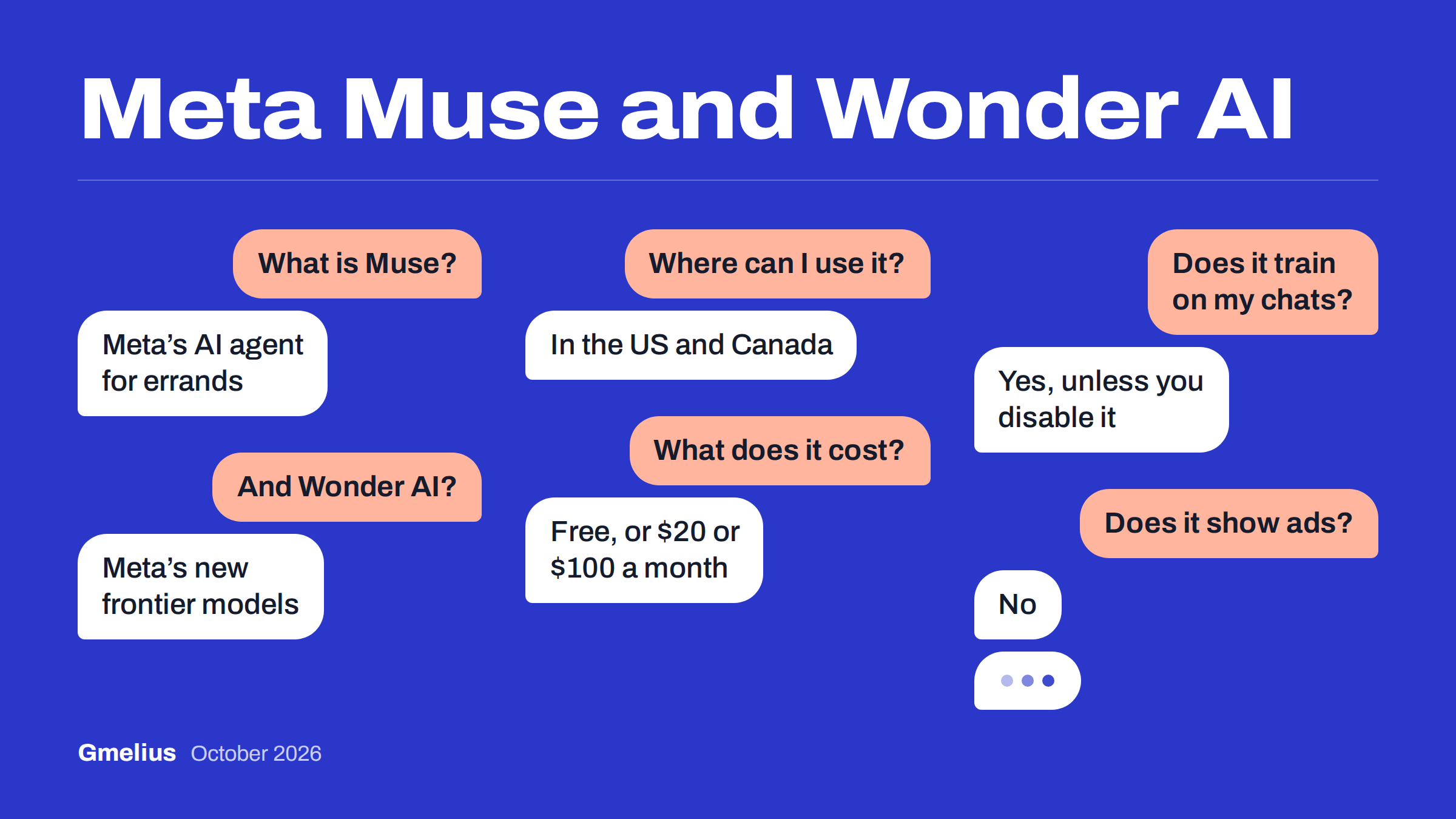
In the US and Canada, Muse works on phones and on the web at muse.ai, and it can also be used inside WhatsApp, while a dedicated iPad app followed on October 7.
Most of Muse is free, although Meta sells two subscriptions, at $20 and $100 a month, for people who use it heavily, and CNBC reported that one of these subscriptions will be needed to use Wonder inside Muse.
For developers, Muse Wonder is sold through the Meta Model API at $4 per million input tokens and $20 per million output tokens, which is the same list price as Anthropic's Claude Opus 5.5, while Wonder Full is available only to Muse Code subscribers on the $50 or $200 monthly plans.
Meta has also shown Muse Charm, a palm-sized device for talking to the agent away from a phone, and the company says it will share more details about it later this year.
How to Get Started With Muse
A new Muse account takes only a few minutes to create, and the choices made in those first minutes decide how much personal data the agent can see.
- Download the app: Muse is free on the App Store and Google Play in the US and Canada, and it can also be opened in a browser at muse.ai. New users sign in with a mobile number or an email address.
- Name the agent: The first screens ask for a name and an avatar for the agent. These choices change how Muse looks and speaks, while the work it can do stays the same.
- Connect apps with care: Muse offers to connect to Gmail and Facebook straight away. For email, read-only access is the safer starting point, since sending rights can be added later, once the agent's drafts have been checked.
- Check the training setting: Conversations are used to train Meta's models by default. The setting can be disabled in the app, and it is sensible to do so before any client or financial details are shared.
- Start with a small errand: A first task, such as comparing prices for a single item or drafting one reply, shows how Muse asks for approval before it acts. Larger goals can follow once that pattern is familiar.
Privacy, Data and Safety
Each Muse works in its own virtual machine, and a second agent called Sentinel, kept apart from Muse at the system level, must approve anything Muse sends to the internet.
Muse never sees the passwords or card numbers stored for it. Meta also says that Muse conversations are not shared with its ad systems. Before the end of 2026, it plans to offer a Confidential VM, encrypted with a key that only the user holds, so that even Meta cannot read the data inside.
Meta uses Muse conversations to train its models unless a person opts out, although it says it removes critical personally identifying information first.
When a conversation is deleted, Muse keeps what it learned from it, according to Meta's Help Center, so a full reset or a request to forget is needed instead. Gmelius has a step-by-step guide on how to delete ChatGPT and Claude history for teams that use more than one AI business assistant.
Atlanta News First, citing Benzinga and Inc., reported cases in which Muse shared a user's home address with a stranger and read private messages without being asked. When Amazon blocked Muse on September 21, it said the agent did not identify itself while browsing and appeared to capture and store customer credentials, although Meta has said that Muse never sees passwords.
Meta has opened a bug bounty for Muse, with payments for researchers who find security flaws. The Wonder models were also trained to avoid sharing private information without permission.
How Muse Compares With ChatGPT and Claude
The closest rivals to Muse are OpenAI's dots, introduced on September 29 as always-on agents with a cloud computer of their own, and Anthropic's Claude Cowork, which completes multi-step office work from a folder of files.
Dots are open to ChatGPT Pro and Business Premium users, and Cowork needs a paid Claude plan, whereas Muse starts with a free tier and a WhatsApp chat.
OpenAI's ChatGPT Work and Claude Cowork both expect a person to ask for a finished piece of work, such as a spreadsheet or a report, while Muse expects an errand, such as a car to sell or a dinner to plan.
In its first 12 days, Apptopia counted 642,000 daily users of Muse in the US, against 231,000 for ChatGPT at the same point after its launch in 2022.
Muse has no advertising, and Mark Zuckerberg has said that Meta expects to profit from a small fee on transactions instead, which puts Muse closer to Claude, which has no ads, than to ChatGPT, which shows ads to free users in the US and several other countries.
Conclusion
Muse has gathered millions of users in five weeks, and Wonder gives it a model that scores close to the best from OpenAI and Anthropic. For personal errands, the pair is already capable, although the privacy settings deserve a careful look before Gmail or a bank card is connected.
A personal agent, however, has no view of who else is working on the same thread. Gmelius was built for that shared view. Meli, its AI agent, drafts replies from the live thread inside Gmail, while the shared inbox assigns each conversation and records who answered it.
Meli also powers an army of AI agents that complete tasks across other applications, but it's informed by a company's business context in a way Meta’s Muse isn’t, at the moment. While Muse deserves a look as one of the most cutting-edge AI apps available today, it falls short of real business needs.
Install Gmelius for free, to trial an agentic army with business context.