



Every few months a new AI tool gets crowned the future of supply chain management, and every few months operations teams quietly go back to their spreadsheets. So when logisticians started publishing Claude reviews with lines like "it surfaced six-figure penalty recoveries from a single contract read," the natural question was whether this one is different.
We spent time with the published case studies, the practitioner write-ups, and the tool itself to answer a simple question: is Claude good for supply chain work, where does it genuinely earn its keep, and where does it fall short without help?
What Claude Is (and Isn't) for Operations Teams
Claude, built by Anthropic, is a reasoning engine that happens to be exceptional at reading. That distinction matters more in supply chain than almost anywhere else, because supply chain work is drowning in documents nobody reads carefully. Forty-page carrier contracts. Customs paperwork. Supplier scorecards that look clean on the dashboard and fall apart in the transaction detail.
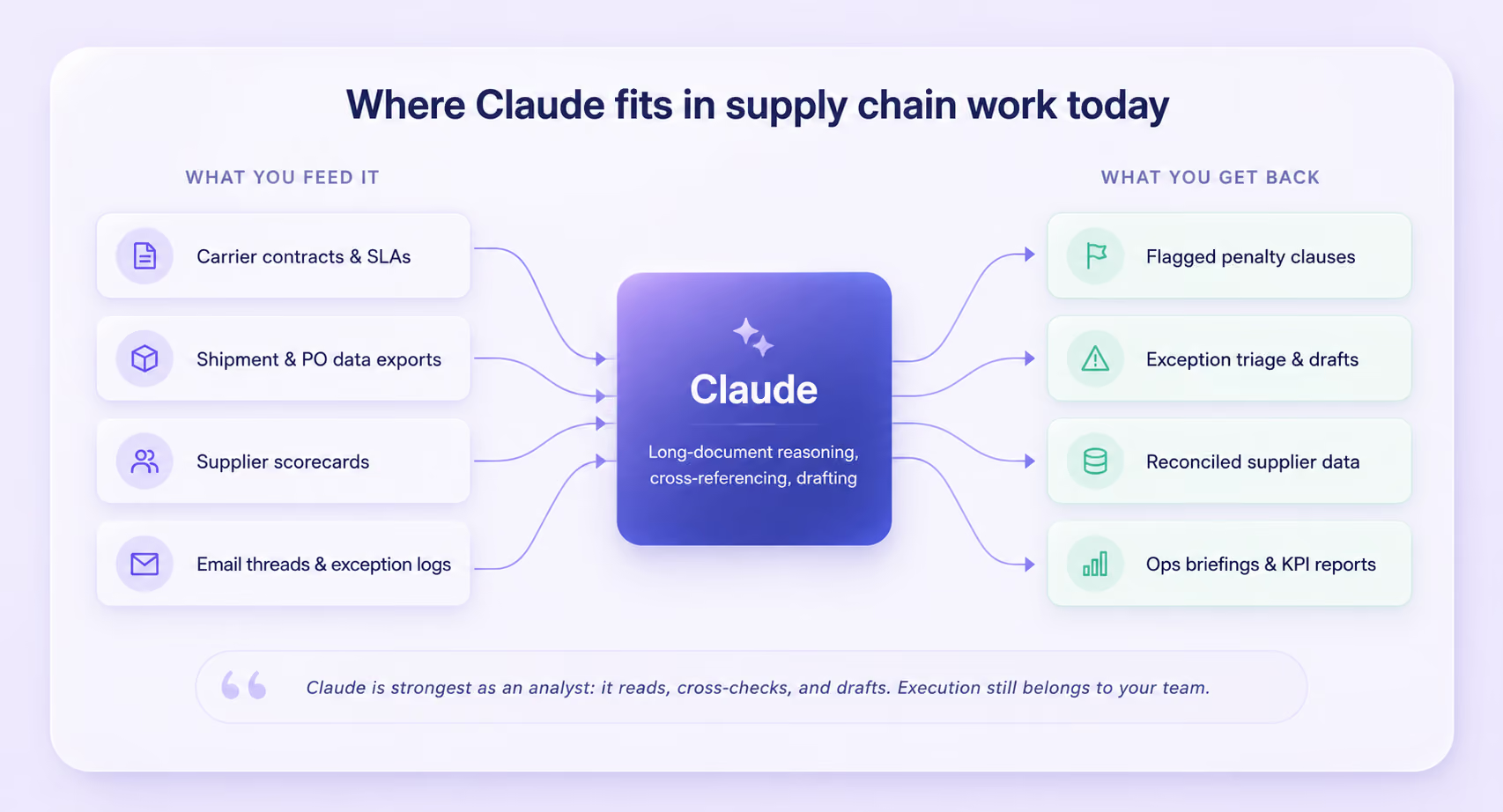
A recent industry analysis found that supply chain leaders spend roughly 40% of their time finding and fixing data inconsistencies across disconnected systems. Claude's core strength maps almost perfectly onto that problem. Give it a contract and the actuals, and it will tell you where they disagree.
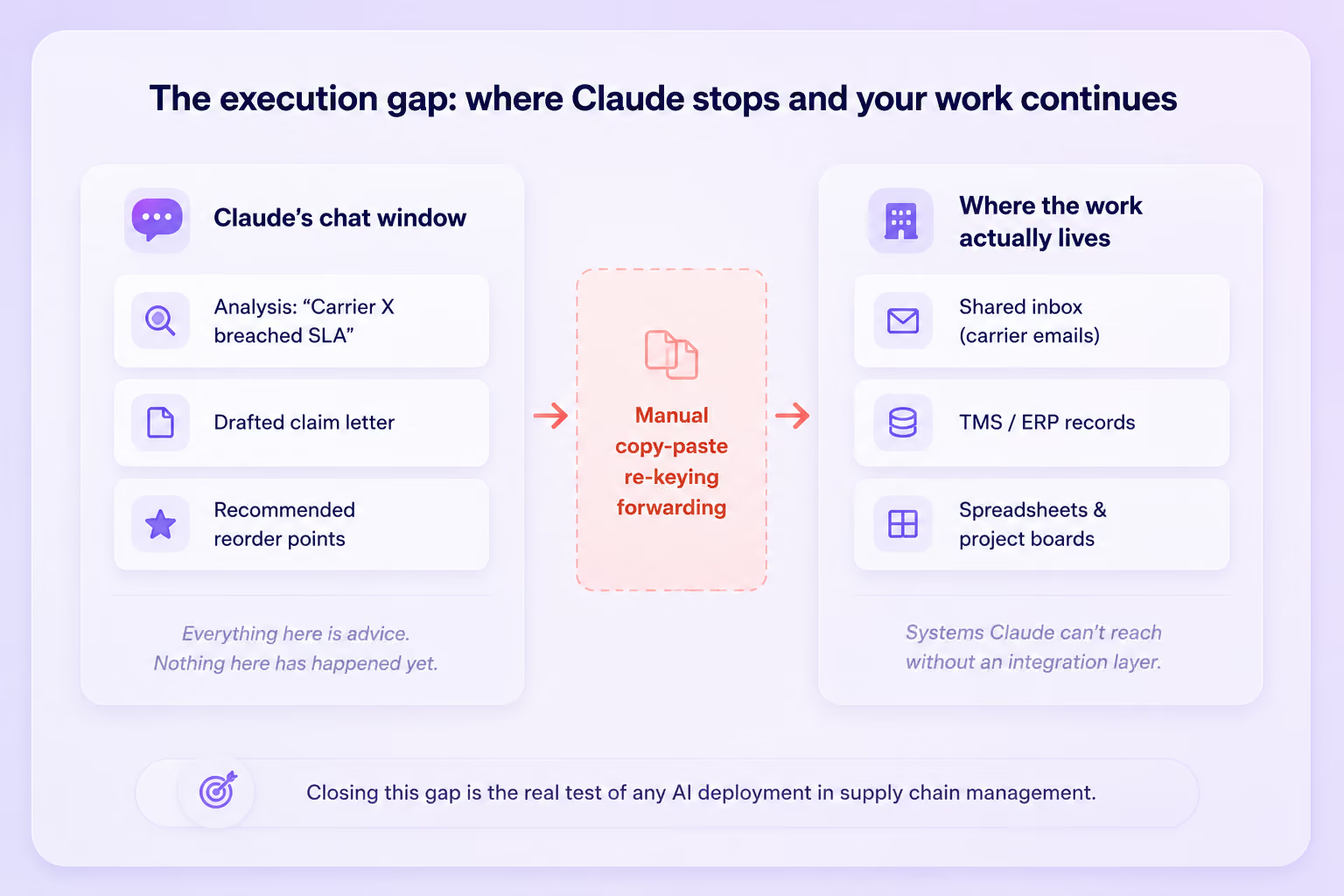
What Claude is not, out of the box, is an execution system. It doesn't sit inside your TMS. It can't see the carrier email that arrived twenty minutes ago unless you paste it in. Keep that in mind as you read any glowing Claude review, because the gap between analysis and action is where most AI deployments in supply chain management go to die. More on that below.
Make No Mistake, Claude Benefits for Supply Chain Management Are Real
The practitioner evidence clusters around a handful of workflows. These are the ones with documented results rather than demo-day promises.
Contract and SLA review at carrier scale
Supplier and carrier contracts are long, dense, and written to protect the other side. Procurement teams using Claude for contract review report surfacing penalty clauses that had sat unclaimed for years, in some cases recovering six-figure sums from a single agreement, simply because the model read the whole document and cross-referenced it against performance actuals. A human could do this. A human almost never does.
For freight and logistics teams, the same capability applies to 3PL agreements, detention and demurrage terms, and SLA commitments buried in appendix C of a contract signed three procurement managers ago.
Exception triage without the 2 a.m. panic
Delivery exceptions and customs holds are the highest-volume, highest-stress work in logistics operations, and this is where consultancies deploying Claude report the clearest early ROI. The model classifies the exception, drafts the customer communication, and proposes a resolution path, cutting handle time on the routine cases so your team's attention goes to the genuinely hairy ones.
One deployment guide put it well: Claude understands the difference between a one-off issue and a systemic problem, and that judgment is what makes triage useful rather than noisy.
Supplier data reconciliation across systems
Your supplier master data lives in three systems and disagrees with itself. Claude's newer desktop capabilities (Anthropic's Cowork product) let it read files directly, compare a supplier's stated 98% on-time delivery against the transaction log showing twelve late shipments last quarter, and flag the mismatch before it becomes a sourcing decision.
One supply chain writer described configuring it as a de facto team member in under fifteen minutes: point it at a folder of contracts and procurement records, and it runs a full reconciliation with a leadership-ready briefing at the end.
The Honest Claude Review: Three Limitations Most Teams Will Face
But our Claude analysis showed that it’s not all smooth sailing:
- It has no native connection to your operational systems. Claude doesn't know your shipment left Rotterdam late unless something tells it. Every analysis starts with you assembling the inputs, which quietly becomes its own job.
- Its output is advice until a human acts on it. A drafted claim letter still needs to be sent. A recommended reorder point still needs to be entered. The model produces excellent decisions and zero completed actions.
- Trust has to be earned per workflow. Teams that tried to automate everything at once abandoned the tool fastest. The pattern among successful adopters is narrow and boring: pick one bounded, repetitive workflow, verify the outputs for a month, then expand.
As a result, Anthropic's own agentic features (Computer Use, for instance, which can log into portals and update records) divide practitioners into cautious adopters and not-yet, and both positions are defensible.
The Execution Gap Is the Real Problem
Supply chain work happens in email, overwhelmingly. Carrier updates arrive by email. Customs brokers communicate by email. Suppliers confirm POs, dispute invoices, and announce delays by email. The industry runs on shared addresses like ops@, freight@, and dispatch@, and the teams behind them.
Claude, for all its analytical power, lives in a chat window on the other side of a copy-paste chasm from that inbox. Every insight it produces has to be manually ferried back into the systems where work gets done. Multiply that friction across a hundred exceptions a week and the productivity gain starts leaking out through the seams.
"Is Claude good?" has a settled answer at this point. The interesting question in 2026 is what architecture puts AI reasoning where the operational conversations already live.
Closing the Gap: Gmelius MCPs and Agents on the Shared Inbox
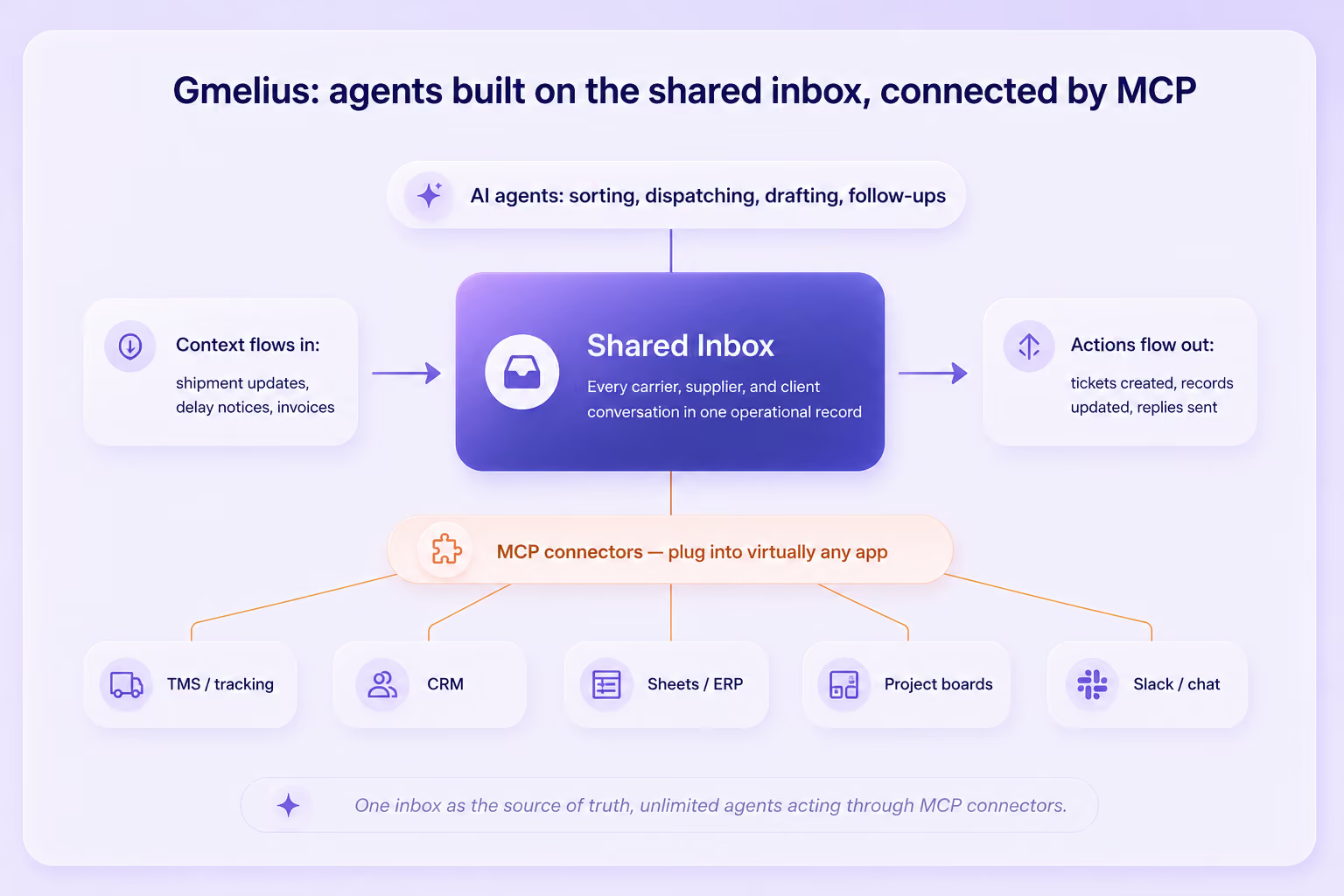
This is the problem Gmelius was built around. Gmelius turns Gmail into a team operations platform: shared inboxes for addresses like freight@ or dispatch@, with assignments, statuses, notes, and Kanban boards layered directly onto the conversations your carriers and suppliers are already sending.
What changes the equation for AI is the architecture underneath. Gmelius supports MCPs, the Model Context Protocol, the same open standard Anthropic created to let Claude connect to external tools.
Through MCP connectors, Gmelius users can plug their inbox-based workflows into virtually any app: a TMS, a CRM, spreadsheets, project boards, Slack. And on top of that connective layer, teams can create effectively infinite agents to execute automated actions, each scoped to a job.
Because the agents are built on the shared inbox architecture, they operate where the context already is. A delay notice from a carrier lands in freight@.
An agent reads it, tags it, routes it to the right coordinator, updates the tracking sheet through an MCP connector, and drafts the client notification in your tone. Nothing was pasted anywhere. The reasoning and the execution happen in the same place, on the same thread, with the full history of that carrier relationship available as context.
Meli, the AI assistant at the center of the Gmelius platform, coordinates this in natural language. Ask it to summarize every open dispute with a specific forwarder, or to build an agent that chases unanswered rate requests after 48 hours, and it does so against the live operational record rather than a pasted excerpt. It's the difference between an analyst you brief and a teammate who was already in the meeting.
For supply chain teams weighing Claude, this is the complementary insight: the model's reasoning is the commodity that's now proven. The shared inbox is the substrate that makes it operational.
Verdict: Does Claude Work for Supply Chain Operations?
Yes, with an asterisk the size of your integration strategy.
As an analyst, Claude for supply chain is the real thing. The contract review results are documented and the exception triage gains are repeatable. Data reconciliation, meanwhile, addresses the single biggest time sink in modern supply chain management. If your team reads long documents, compares disagreeing datasets, or drafts high-volume operational communication, the ROI case writes itself.
As an execution layer, Claude alone leaves you carrying its output across the gap by hand. The teams getting compounding value are the ones pairing frontier reasoning with an architecture that lives where the work does.
If your operations run through email (and in freight, logistics, and vendor coordination, they do), building your agents on the shared inbox with MCP connectivity is how the analysis stops being advice and starts being done.
Start narrow. One workflow, one agent. Then let it multiply. Start with Gmelius for free.