



Logistics dispatchers spend most of the workday inside email. Carrier rate confirmations, exception alerts, customs paperwork, detention notices, and customer status updates move through the same inbox that handles everything else a dispatch desk touches in a day.
A single delayed shipment can generate ten or more of those messages before the exception is resolved, and none of them wait for business hours. This is the part of logistics that rarely makes it into a trade publication. Route optimization and warehouse robotics get the headlines. But the inbox, where a dispatcher actually spends the bulk of the day negotiating rates, chasing a proof of delivery, and explaining a delay to a customer, gets treated as background noise rather than the operational core it actually is.
Agentic email is the technology built to change that.
What is Agentic Email?
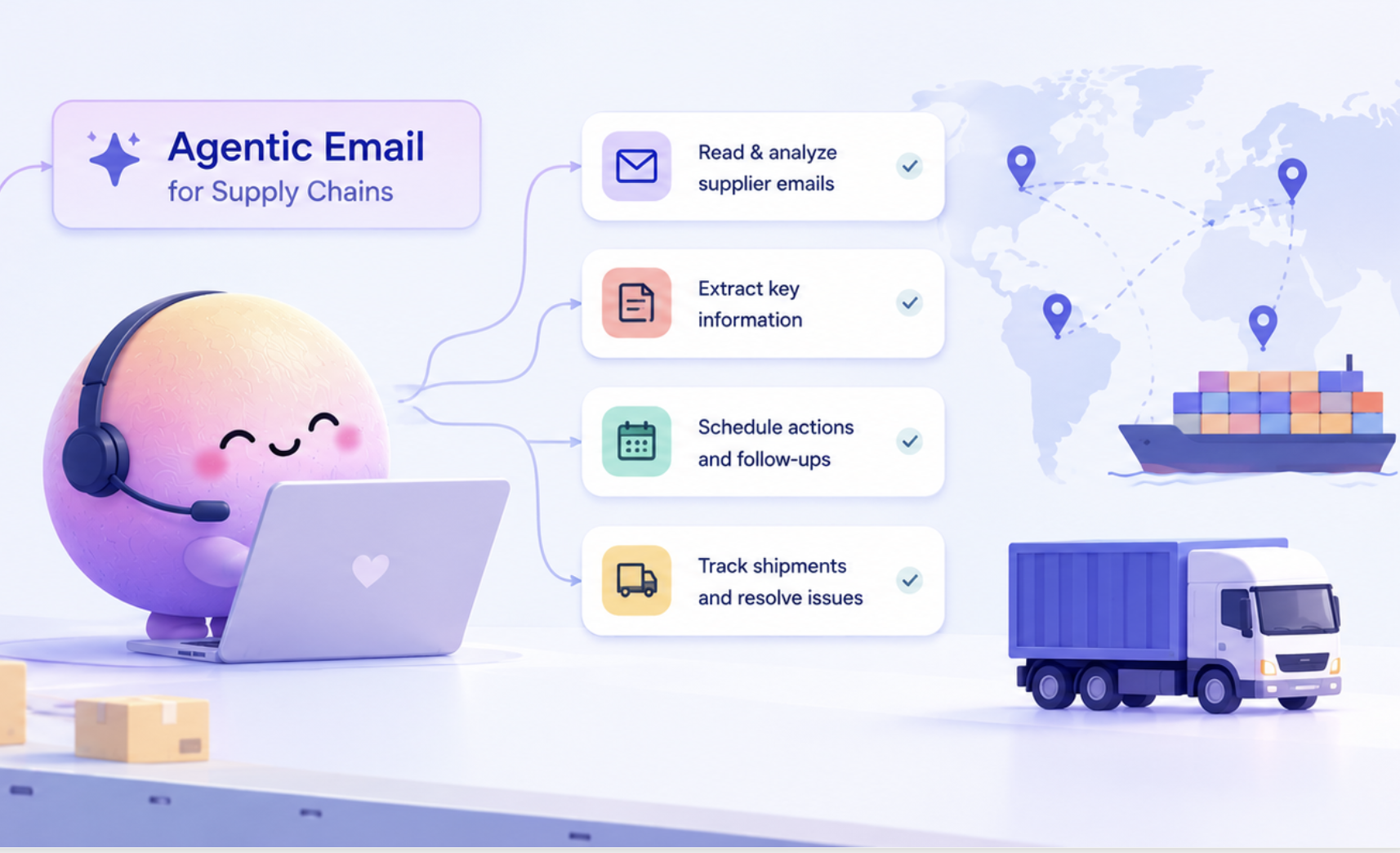
Agentic email is an inbox that acts on what it reads instead of just displaying it and can act on what it sees.
A traditional inbox waits for a person to open a message, decide what it means, and type a reply. An agentic inbox reads the message, checks it against context from a shipment record or a TMS, and drafts, sends, or escalates a reply on its own, within limits a team sets in advance. The email itself looks the same. What changes is who, or what, acts on it first.
Why Logistics Teams Are Struggling
A LeanDNA survey of 250 supply chain, inventory, and planning executives found that supply chain professionals spend nearly 14 hours a week, almost two full workdays, manually tracking data that already exists somewhere in their own systems.
Much of that tracking happens over email: a rate confirmation retyped into a TMS, a delivery status copied into a spreadsheet, a customs document matched by hand against a shipping manifest.
Trust makes the problem harder to solve with a general AI tool. Freight communication carries customer pricing, shipment contents, and route data that a broker or carrier does not want exposed to a new AI platform with no established security record.
The FBI has warned that threat actors have infiltrated broker and carrier systems through spoofed emails and fraudulent links since at least 2024, using that access to post fake load listings, impersonate legitimate firms, and reroute real shipments.
A compromised inbox can redirect a shipment, alter a customs document, or manipulate a rate confirmation before anyone notices the message was never genuine.
Cost adds another barrier. Popular LLM platforms become increasingly expensive as more tasks get automated, which works against a logistics team's actual incentive to automate more of its email, not less. Adopting one also means a dispatcher learns a new interface, reconnects TMS and carrier logins outside the inbox, and translates freight terminology,
MC numbers, accessorial charges, and lane codes, that a general-purpose tool was never trained to recognize. What logistics teams need is not a separate AI tool bolted onto the workflow, but smart email that works from inside the inbox a dispatcher already trusts, addressing the decades-old barriers that have kept logistics communication stuck on manual handling long after other parts of the supply chain automated.
How AI Agents Can Help
An agent built for a logistics inbox handles the categories of email that repeat every week: reading an incoming message, classifying what kind of request it is, pulling the relevant shipment or carrier record, and drafting or sending a reply based on the permission it has been given.
A rate confirmation follow-up goes out the moment a response window closes. A proof of delivery request gets drafted the instant a shipment status changes to delivered. A detention notice gets flagged the moment a truck waits past the agreed dock time, before the charge becomes a dispute.
None of this requires a dispatcher to open a separate application, and the improvement compounds with use. An agent that reads a company's own supply chain communication history learns which carriers respond faster to a phone call than an email, which customers escalate after two follow-ups instead of three, and which lanes generate exceptions more often than others, patterns a generic AI tool trained on a general business email dataset has no access to.
How to Choose an AI Agent Platform
Not every platform marketed as an AI agent does the same job, and the differences matter more in logistics than in most industries. A team evaluating options should look at four things before signing anything.
- Where does it run? A platform that lives inside Gmail, reading and drafting where a dispatcher already works, avoids the login sprawl and retraining cost of a bolt-on tool.
- How does it learn? A platform trained only on general business email will draft generic replies. One that reads a company's own carrier and customer history will draft something closer to what a dispatcher would have written.
- How deep does the integration go? An agent that only drafts email is a smaller win than one that reads and writes back to a TMS, a carrier portal, or an EDI feed, closing the loop instead of creating a second record to reconcile later.
- How do permissions work? A platform should let a team set autonomy category by category, not as a single on-off switch for the whole inbox.
Because the AI agent category has grown fast, a side-by-side look helps. Comparisons of the best AI email automation software and the best AI agents for work on the market in 2026 are worth reading before committing to one, as are breakdowns of which AI assistant features actually reduce time spent in an inbox versus which ones just look good in a demo.
Safety Valves that Logistics Teams Need Before Using AI Agents
Freight contracts increasingly specify data handling terms for rate information and customer details, terms closer to what a healthcare or financial contract requires than what a general business email tool assumes. Before a logistics team lets an agent touch a live inbox, three safety valves need to already be in place.
The first is certification. SOC and HIPAA certification exist for a reason: they force a vendor to prove, on an ongoing basis, that data handling meets a regulated standard rather than a marketing claim.
The second is data retention. Freight communication regularly includes personal data covered under regulations like GDPR, which require that information be deleted once it's no longer needed for the service it supported, a discipline that has to be built into the platform by default rather than left to a dispatcher remembering to clean up a thread months later.
The third is documentation itself. Compliance certificates, customs paperwork, and audit trails are frequently shared over email management for supply chain operations workflows, and an agent handling that traffic needs the same access controls a compliance team already applies to the rest of the operation.
How Meli Delivers Safe and Purpose-Built AI Agents
Gmelius is an SOC and HIPAA-certified AI company, and its agents are powered by Meli, the AI Chief of Staff that continuously learns about a business from its own inbox, work patterns, and team writing style. Every agent built for a logistics team runs on four parts.
- Trigger: A specific event or timestamp that starts the agent, like a carrier missing a pickup window, a shipment status changing to delivered inside the TMS, or every Monday at 9 am for a standing report to a fleet manager.
- Action: The work the agent does once triggered. This could be a single-step task, like drafting a proof of delivery request, or a longer sequence: flagging a detention charge, drafting the notice to the customer, escalating it to the account manager as a ticket, and notifying that manager on Slack.
- Integration: The systems the agent reaches to complete the action, for example a TMS to check shipment status, a carrier portal for tracking data, an EDI feed for status codes, or Slack for internal alerts.
- Permission: The autonomy the agent is granted. One agent may draft an exception notice but not send it, while another replies to a routine status request on its own.
"Freight moves on relationships and reputation as much as it moves on rate. An agent that gets a detail wrong at three in the morning costs a lane, not just a message. Gmelius brings this technology into the inbox logistics teams already trust, not a new one they have to learn from scratch."
Gmelius ships with agents already built for the categories of email that repeat every week inside a logistics operation, including shipment exception alerts, rate confirmation follow-ups, detention and demurrage notices, customs document requests, proof of delivery requests, carrier onboarding checks, and VIP shipper alerts that reach an account manager the moment a top customer's shipment hits trouble.
A dispatcher can also describe a new agent in plain language, the way they would explain a task to a new hire, and have Meli build it inside the Gmelius interface within minutes, a capability the company expanded through 2025 as part of Meli's Year in AI, evolving it from a drafting assistant into something closer to a digital chief of staff for the whole inbox.
How Logistics Teams Benefit
Enterprise freight operations have already proven the category works at scale. C.H. Robinson runs more than 30 AI agents across pricing, classification, order processing, and proof of delivery, and reported in January 2026 that two of them handle missed LTL pickups for more than 11,000 shippers, automating 95 percent of the checks and saving over 350 hours of manual work every day.
DHL Supply Chain partnered with HappyRobot in late 2025 to put agents into appointment scheduling and driver follow-up calls, and RXO said its AI handled more than 500,000 calls in the first quarter of 2026 alone.
Those are companies with engineering teams built to support a deployment like that. A regional broker or a fifteen-person 3PL does not have that, and should not need it. The benefit for a smaller logistics team is the same category of outcome, faster replies, fewer retyped fields, fewer missed follow-ups, delivered through a shared inbox platform the team is already using rather than a system it has to build from scratch.
A dispatcher keeps the same carrier relationships and the same customer contacts. What changes is which messages get drafted automatically and which still need a person to read them first.
Logistics Coordination Beyond Email: Switching to AI Agents
Once an agent is reading and writing across a TMS, a carrier portal, and Slack, the inbox stops being the only place coordination happens. A detention notice drafted by an agent can update the shipment record at the same time it reaches the customer.
A carrier onboarding check can confirm an MC number and log the result without anyone opening a second tool to verify it. The email is still there, but it becomes one output of a process instead of the entire process itself, closer to the kind of communication in supply chain management that a dispatch team has always wanted and rarely had the infrastructure to run.
"The inbox we know is dying, and nowhere is that clearer than in freight, where the inbox has always doubled as the operations desk. With agents now able to work across a TMS, a carrier portal, and Slack, and learn from years of dispatch history, it's possible to automate far more of a logistics inbox than we could previously imagine."
The inbox does not disappear from a logistics operation, and the volume moving through it is not shrinking either. What changes is how much of that volume still needs someone to open the message, decide what it means, and type a reply by hand.
Ask for a Gmelius demo to see agentic email for logistics in action.


.png)

.avif)
![The Inbox is Dead: Why Agentic Email is the Future of Business Operations [Report]](https://cdn.prod.website-files.com/6737568a4ac417efeb387e5a/6a9af4cfa0722cc7ec2cb09b_6d09ad75-441e-4279-93ad-0b094bc82b2a.avif)
.avif)