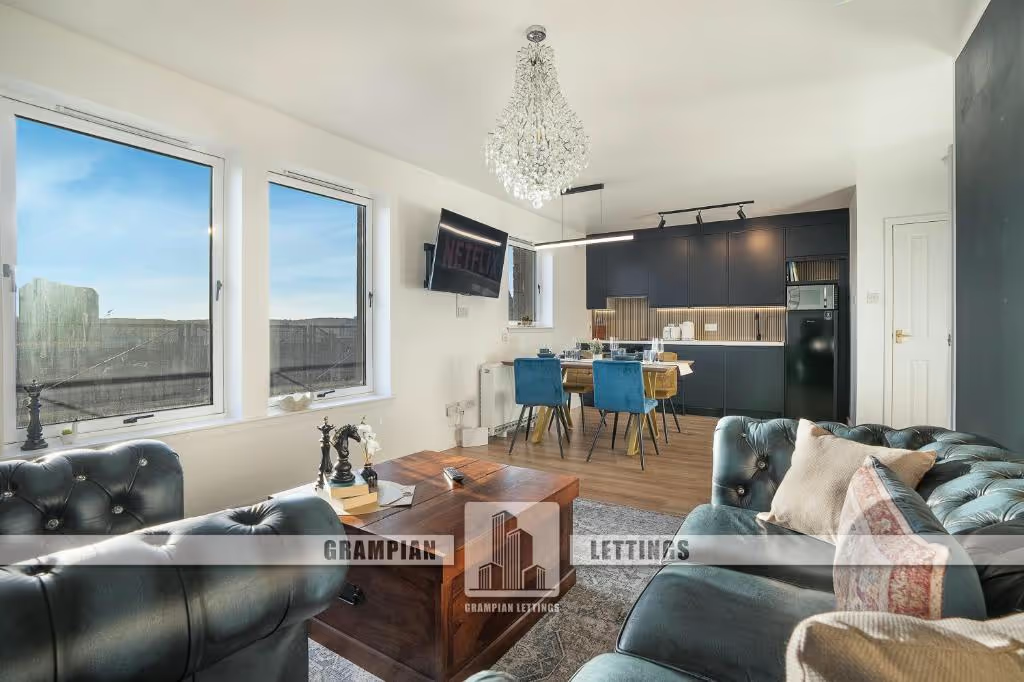
Grampian Lettings is a property management company headquartered in Aberdeen, Scotland. The firm manages a growing portfolio of 50+ serviced apartments and short-term rental properties across Aberdeen City and Shire, catering to both leisure and business guests.
As the portfolio expanded, so did the volume of tenant queries, maintenance requests, landlord communications, and internal follow-ups flowing through the team's Gmail inboxes. The founder (Edwin) needed a way to bring structure and visibility to email-driven operations — without forcing the team off the tools they already used every day.
The Problem
Property management runs on responsiveness. A missed maintenance request or a delayed reply to a landlord can erode trust fast. And when multiple team members share responsibility for the same inbox, things fall through the cracks even faster.
That was exactly the challenge Grampian Lettings faced.
As the company scaled its property count and guest volume, email became both the team's primary workspace (and its biggest liability).
Messages piled up in shared Gmail accounts with no clear ownership. Two people would reply to the same tenant, or worse, neither would, each assuming the other had it handled.
There was no system to track who was responsible for what, no way to measure how quickly the team was responding, and no mechanism to enforce consistent workflows across recurring tasks.
The root causes were structural, not individual. Gmail, by default, simply isn't built for team-based operations. It lacks native task routing, accountability tracking, and automation, all of which a growing property management firm needs to function at speed. Edwin recognized that the bottleneck wasn't effort; it was the absence of operational infrastructure inside the tool his team already lived in.
The Answer
Rather than migrating to an entirely new platform, Grampian Lettings adopted Gmelius, layering operational capabilities directly on top of Gmail.
1. Collaborative Gmail
Shared inboxes gave the team collective visibility into every conversation without forwarding, CCing, or duplicating threads.
Tenant queries, landlord messages, and maintenance requests all landed in centralized inboxes where every team member could see status at a glance, and where ownership was always clear. Notes allow team members to collaborate directly on an email.
2. If-This-Then-That Rules
Automation rules replaced the manual sorting and triaging that had consumed hours each week. Incoming emails were automatically tagged, categorized, and routed based on predefined conditions, which are highly configurable. This ensured the right person received the right message without anyone needing to intervene.
3. Emails assigned as tasks
Task assignments via round-robin distributed workload evenly across the team, eliminating the guesswork of "who should handle this?" Every incoming request was assigned an owner the moment it arrived, creating immediate accountability.
4. Insight into performance
Performance tracking and email analytics gave Edwin the visibility he'd been missing. Response times, resolution rates, and individual workloads became measurable, meaning email went from being a black box to an auditable, improvable process.
The Results
Over four years, the impact has compounded. What started as a fix for inbox confusion evolved into a full operational backbone.
1. Less email bottlenecks
Messages no longer sit unattended in a shared account waiting for someone to claim them. Automation and task routing ensure every email reaches the right person immediately, keeping response queues short and workflows moving. The team spends less time sorting and more time solving.
2. Zero confusion about who's handling what
Shared visibility and automatic assignment eliminated the overlap and ambiguity that once plagued the team. Every conversation has a clear owner from the moment it arrives, and the entire team can see that ownership in real time. As Edwin puts it: "Gmelius has allowed us to transform Gmail from a simple inbox into a structured operations hub."
3. Faster responses to customers
With bottlenecks removed and ownership clear, tenants and landlords now receive replies significantly faster. In a business where responsiveness directly affects reviews, retention, and referrals, that speed translates into measurable trust.
4. Greater accountability among teams
Analytics made individual and team output visible for the first time. Edwin can now track response times and workload distribution across the team, creating a culture of accountability without micromanagement.
"Over the last four years, we've seen Gmelius mature into a serious operational tool rather than just an email add-on. Each update has felt purposeful."
5. Standardized processes, low complexity
Automation rules enforced consistent workflows across recurring task types (from maintenance escalations to landlord updates) without requiring the team to learn a new platform. The operational rigor came without the operational overhead.
The cumulative effect is a team that scales confidently. "Gmelius has become a core part of our infrastructure. It allows us to scale without chaos — and in property management, that's everything," Edwin says.
Achieve Similar Outcomes for Your Team
Gmelius turns Gmail into a collaborative operations platform, bringing shared inboxes, workflow automation, task management, and analytics to teams that need enterprise-grade capability without enterprise-grade complexity.
With dedicated integration and implementation support, Gmelius delivers secure, compliant solutions tailored to your workflows. And with Meli, its AI-powered assistant, teams can now automate even more of the repetitive work that slows them down — so they can focus on the work that actually matters.

.avif)
.avif)
.avif)